
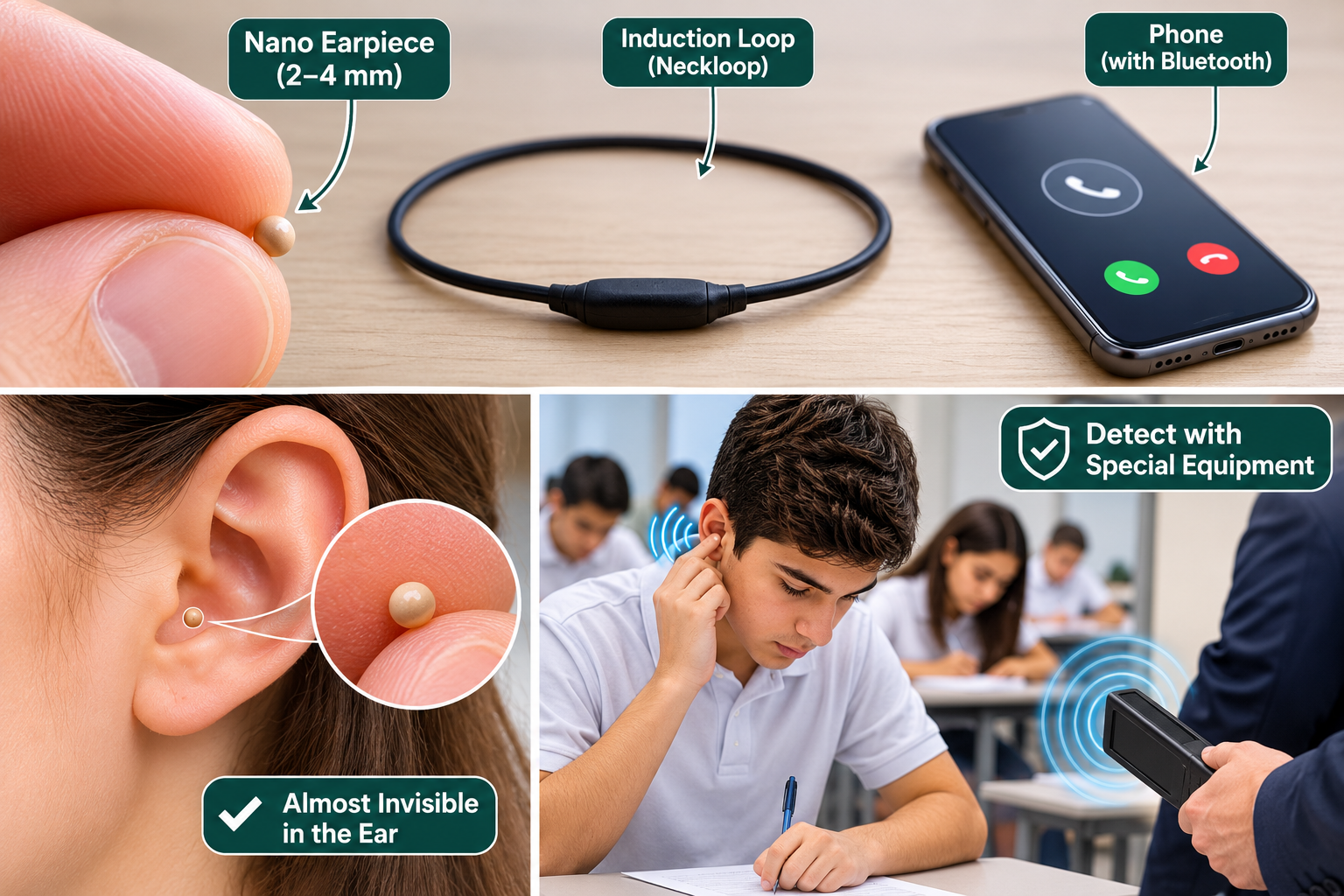
A few months ago the exam office of one of the universities we supply asked us a question we couldn’t answer yet: “Can you find something that catches the earpieces?”
They weren’t talking about AirPods. They meant nano earpieces: the tiny magnets students push deep into their ear canal to hear answers read out by someone outside the exam hall. Some of their staff called it a hidden headset, others a tiny headset or a spy earpiece. It took a while to realise everyone was describing the same device. The invigilators were sure students were using it. Grades in some courses didn’t make sense. But nobody had ever actually caught one, because there was nothing to see.
We spent the following weeks learning how the nano earpiece works and looking for the few companies that build equipment to detect it. This post covers what we learned. If you run exams at a university, a licensing body or a test centre, it should help you understand what you’re up against.
What a nano earpiece actually is
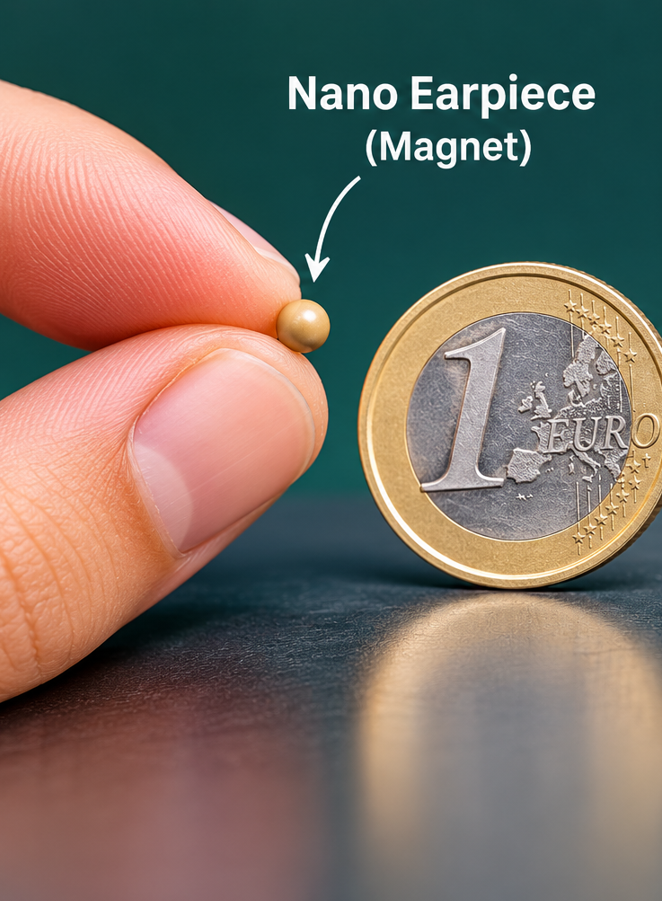
The name makes it sound like a tiny speaker. It isn’t. A typical nano earpiece is a small neodymium magnet, usually between 2 and 4 millimetres, sometimes wrapped in a skin-coloured coating. There’s no battery in it, no chip and no antenna. On its own it does nothing at all.
It works because of a second device: an induction loop, also sold as a neckloop, induction collar or inductive necklace. It’s a thin wire loop worn around the neck, hidden under a shirt collar, a scarf, a hijab or a lanyard. The loop connects to a phone, usually over Bluetooth, sometimes with a thin cable. When the phone plays audio, the loop turns it into a changing magnetic field. The magnet in the ear sits inside that field and vibrates with it, and the student hears the vibration as sound.
Put together, the hidden earpiece setup looks like this:
- A friend outside the hall gets the questions, from a hidden camera, a photo sent early in the exam, or a leaked paper.
- They call the student’s phone, which is on silent in a pocket, a bag, or taped somewhere on the body.
- The phone sends the call audio over Bluetooth to the neck loop.
- The loop drives the nano earpiece in the ear.
- The student listens and writes. Some spy earpiece kits include a hidden microphone so the student can whisper or tap to ask for the next answer.
The whole kit can be bought online for less than the cost of a textbook, and sellers market it openly as an exam cheating earpiece.
Hidden headset, tiny headset, spy earpiece: the names you'll hear
Part of what makes this hard to deal with is that nobody uses the same word for it. Search any marketplace and you’ll find the same product listed as a:
- Nano earpiece or nano earphone
- Hidden earpiece or hidden headset
- Invisible earpiece or invisible headset
- Tiny headset or tiny earpiece
- Micro earpiece, micro earphone or mini earpiece
- Spy earpiece, spy earphone or spy earbud
- Covert earpiece
- Magnetic earpiece or inductive earpiece
- Bluetooth spy earpiece or GSM earpiece
In the Gulf and Egypt, students and parents usually say سماعة نانو or سماعة الغش. Whatever the name, there are really only three types:
- Magnetic nano earpiece + induction loop. The smallest and most common. The earpiece is a passive magnet, as described above.
- Bluetooth micro earpiece. A tiny capsule with its own battery that pairs straight to a phone. Bigger than a magnet, but no neck loop needed.
- GSM earpiece. Takes its own SIM card, so it can receive a call without any phone in the room at all.
This isn't a rare problem
When we started, we assumed hidden earpieces were a niche trick. The news from our own region says otherwise.
In January 2023, Kuwait’s education authorities reported that 1,741 students had been caught cheating or trying to cheat during a single round of midterm exams. Earpieces were being sold to students for up to KD 150 each as part of an organised leak network (Kuwait Times). Back in 2018, a Kuwaiti student ended up in the emergency room after pushing a Bluetooth earpiece so deep into his ear that he couldn’t get it out. He then asked for it back because he needed it for the next day’s exam (Gulf News).
Those are the ones that got caught. The exam offices we speak to believe the real numbers are far higher.
Why invigilators miss a hidden earpiece
Most anti-cheating rules focus on phones and watches on the desk. The nano earpiece was designed to get around exactly that.
- You can’t see it. The magnet sits deep in the ear canal. Even looking straight into the ear with a torch, you’d probably miss an invisible earpiece.
- It’s silent to everyone else. Unlike a regular earphone, almost no sound leaks out of a tiny headset.
- Walk-through metal gates don’t react. A few grams of magnet is far below what a gate is set to catch.
- The phone isn’t on the desk. It’s in a bag at the back of the room, in a pocket, or sometimes left in a bathroom for a break-time handover.
And in the UAE, like most of the region, you can’t solve the problem with a signal jammer. Jammers are prohibited by the telecom regulator, and even where they’re allowed, they block emergency calls for everyone in the building.
Signs a student may be using a spy earpiece
Experienced invigilators do pick up on behaviour. None of these prove anything alone, but together they’re worth a closer look:
- Touching or pressing on one ear, or tilting the head as if trying to hear better
- Long pauses followed by a burst of fast writing, repeated through the paper
- Lips moving slightly, or quiet tapping, when the candidate should be silent
- A high collar, scarf or thick lanyard that stays on even in a warm room
- Unusual interest in a bathroom break at a specific point in the exam
The trouble is that suspicion isn’t evidence. Without something that confirms a hidden headset is there, most exam offices won’t act, and they’re right to be careful.
How to detect a nano earpiece
Here’s the useful thing we learned: every part of this setup leaves a physical trace. It just isn’t a visible one.
1. The magnet
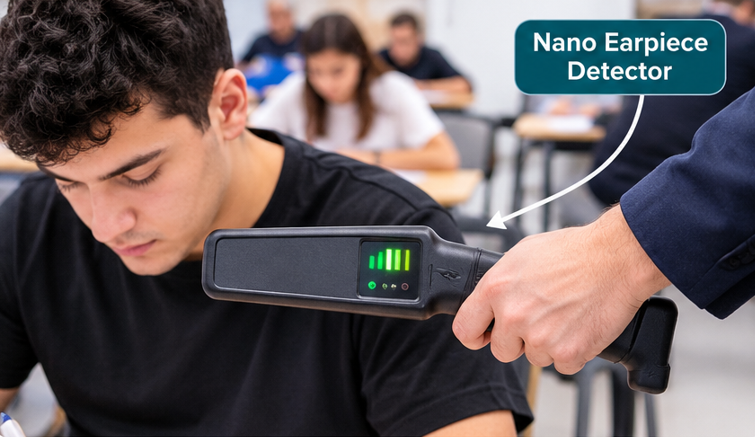
The nano earpiece has no battery, but it’s still a strong magnet. A close-range magnetic sensor passed near the ear will react to it. This is how you find a magnetic earpiece even when the loop is switched off.
2. The induction loop’s field
While audio is playing, the neckloop creates a low-frequency electromagnetic field around the upper body. A detector tuned to that range picks it up clearly. This is the best moment to catch a spy earpiece, because it’s in active use.
3. The phone, Bluetooth and GSM signals
The loop gets its audio from a phone on a live call, and Bluetooth or GSM micro earpieces transmit on their own. An RF detector flags active GSM, 4G/5G, Bluetooth and Wi-Fi signals near a candidate, which leads you to the device even when it’s well hidden.
No single method is perfect. A student can switch the loop off for a minute, or put the phone in airplane mode. That’s why the hidden earpiece detector worth buying combines several of these sensors in one handheld unit. Beating all of them at once is very hard.
Putting earpiece detection into practice
Buying a detector is the easy part. What matters is how it’s used. From what we’ve seen, a workable routine looks like this:
- Tell candidates beforehand. Add a line to the exam rules saying electronic screening for hidden earpieces may happen at entry and during the exam. It works as a deterrent and it protects the institution if a case is challenged.
- Collect medical declarations. Hearing aids and cochlear implants will trigger a magnetic detector too. Ask candidates to declare them at registration so there’s never an awkward moment for an honest student.
- Scan at the door. A few seconds across the head, neck and chest as candidates come in.
- Walk the rows. Invigilators carry the detector with silent (vibration) alerts. If someone shows the signs above, a pass near them confirms a tiny headset or clears them without disturbing the room.
- Re-scan after breaks. A lot of handovers happen in bathrooms.
- Have a written process for a positive alert. Who is called, where the candidate is taken, how the device is recorded. Decide this before exam week, not in the middle of it.
What this means for exam offices
Nano earpieces are cheap, easy to buy, and until now the chances of getting caught were close to zero. That’s what makes them spread. The good news is that the technology to stop them exists. It’s specialised and only a few manufacturers build it well, which is why we partnered with one of them to bring a proper nano earpiece detector to the universities and institutions we already work with.
If you’d like to see what it picks up, we run live demos with a real nano earpiece and induction loop, and your invigilators can try it themselves. Read more on our nano earpiece detector page or book a demo with our team.
Quick answers
Is a hidden headset the same as a nano earpiece?
Usually, yes. Hidden headset, tiny headset, invisible earpiece and micro earpiece are all names for the same kind of device. Most of them are magnetic nano earpieces driven by a neck loop, though some are small Bluetooth or GSM capsules.
Is a nano earpiece the same as a Bluetooth earpiece?
No. A Bluetooth earpiece has its own battery and radio. A nano earpiece is just a magnet, and the Bluetooth part is in the neck loop instead. That’s why it can be so much smaller.
Can a phone app detect a spy earpiece?
Not reliably. Phone magnetometer apps aren’t sensitive enough at the right range, and they can’t read the loop’s field or tell you what’s making a signal. Dedicated earpiece detection equipment is needed.
How do students get the nano earpiece out after the exam?
Kits usually come with a small magnetic stick for pulling it out. If it’s pushed too deep it can need a doctor to remove it, as the Kuwait case above shows.